When we talk about earthmoving machines, the powerful equipment that dominates construction sites and excavation areas immediately comes to mind. But what exactly does “earthmoving” mean? Is it a synonym for “excavations” or is there something else?
Get ready for a full immersion in the world of construction sites: we will explore the practices and equipment essential to complete each operation!
Excavation and earthmoving: why is it important?
Excavation and earthmoving consist of a series of activities that aim to modify the natural conformation of the land to meet the specific needs of a project.
They are important activities in numerous fields. In construction, excavation and earthmoving are used to prepare the area for the construction of buildings, roads and infrastructure, or for the installation of distribution lines. In agriculture, to improve the cultivability of the land it is often necessary to carry out environmental transformations, as in the case of terracing or leveling.
Each operation requires specific equipment and qualified personnel to ensure safety, efficiency and respect for the environment.
Excavation: the most common earthmoving
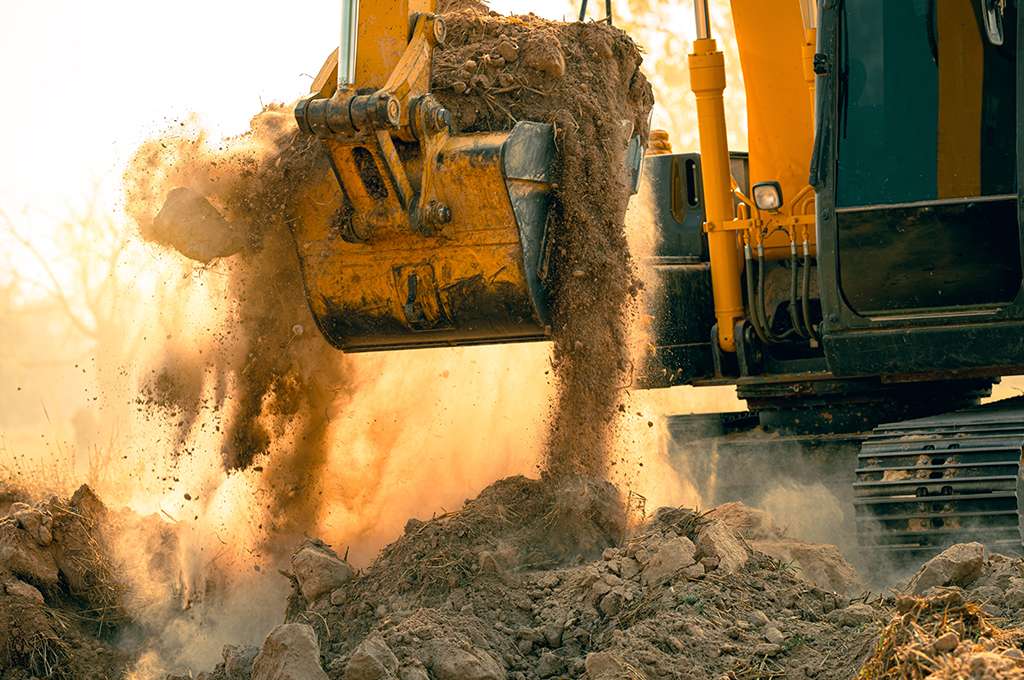
Excavation is one of the main activities of earthmoving and consists of removing materials such as soil, rocks or other debris to modify the level of the ground surface.
Excavation mainly uses excavators, often supported by wheeled or tracked loaders for loading the materials and by dumpers for transporting them to disposal areas.
Types of excavation
Slab excavation (or superficial scotic)
This type of excavation consists of removing the surface layer of the ground without significantly modifying its natural conformation. It is used to:
- Eliminate vegetation, rocks or small constructions present on the surface.
- Create a more homogeneous base for subsequent operations.
The depth is usually limited, varying from a few centimetres to a maximum of one or two metres.
Land clearing excavation
This excavation profoundly modifies the profile of the ground, removing large volumes of material. It is mainly used in construction projects that require large changes to the ground level, such as the construction of roads, buildings or infrastructure.
Selective excavation
Selective excavation is carried out to remove specific areas of soil containing pollutants or unwanted substances. It is particularly common in environmental remediation operations.
Tunnel excavation
This technique is used when the excavation does not take place in the open air but in tunnels or passages, as in the case of road tunnels. Here, specific machinery comes into play, such as milling machines and drills, which work in synergy with more common earthmoving machines such as shovels and dumpers.
Narrow-section excavation (or trench)
This technique is characterized by its shape: a long and narrow excavation, similar to a trench. It is mainly used for the installation of pipes, cables or gas lines. This type of excavation requires particular attention to safety, as the walls of the trenches can collapse if not adequately reinforced.
Other earthmoving operations
In addition to excavation, other earthmoving operations are essential to obtain a ground ready for the subsequent work phases.
Leveling
Leveling consists of eliminating surface irregularities to create a uniform base. It is performed using bulldozers or excavators, machinery capable of leveling large surfaces with precision.
Compaction
After excavation and leveling, the ground may contain empty spaces that make it unstable. Compaction, carried out with compacting rollers, increases the density of the ground, making it:
- More stable and resistant to the weight of machinery or structures.
- Less subject to problems such as water stagnation or bogging down.
Compaction is a crucial phase to avoid subsidence or deformations of the ground over time.
Consolidation
Consolidation is an operation that aims to stabilize the ground to avoid landslides, mudslides or other instability phenomena. This technique is particularly useful in hilly or mountainous areas, where the ground tends to slide due to gravity or erosion.
Terracing
A specific variation of consolidation is terracing, which consists of transforming a sloping terrain into a series of horizontal shelves, called terraces. This approach is widely used in agriculture to grow cereals and other crops on hilly or mountainous terrain. It can also be used in construction, to stabilize steeply sloping areas intended for construction.
Terracing modifies the profile of the terrain, making it similar to a ladder and allowing for safer and more stable management.
Excavation and earthmoving equipment
Earthmoving operations require the use of specific machinery, each designed for well-defined tasks. Among the main ones we find:
- Excavators for excavation and loading operations of materials.
- Loader shovels for loading rock and earth.
- Dumpers for transporting the removed materials.
- Bulldozers and bulldozers for leveling the terrain.
- Compaction rollers to increase the density of the soil.
And here is a short table to clarify and help you understand at a glance which machines you need to carry out excavations and earthmoving!
|
|
Excavator |
Loader |
Dumper |
Bulldozer |
Compaction rollers |
|
Excavation |
x |
x |
x |
|
|
|
Leveling |
|
|
|
x |
|
|
Compaction |
|
|
|
|
x |
|
Consolidation |
x |
x |
x |
|
x |
|
Terrace |
x |
x |
x |
|
|