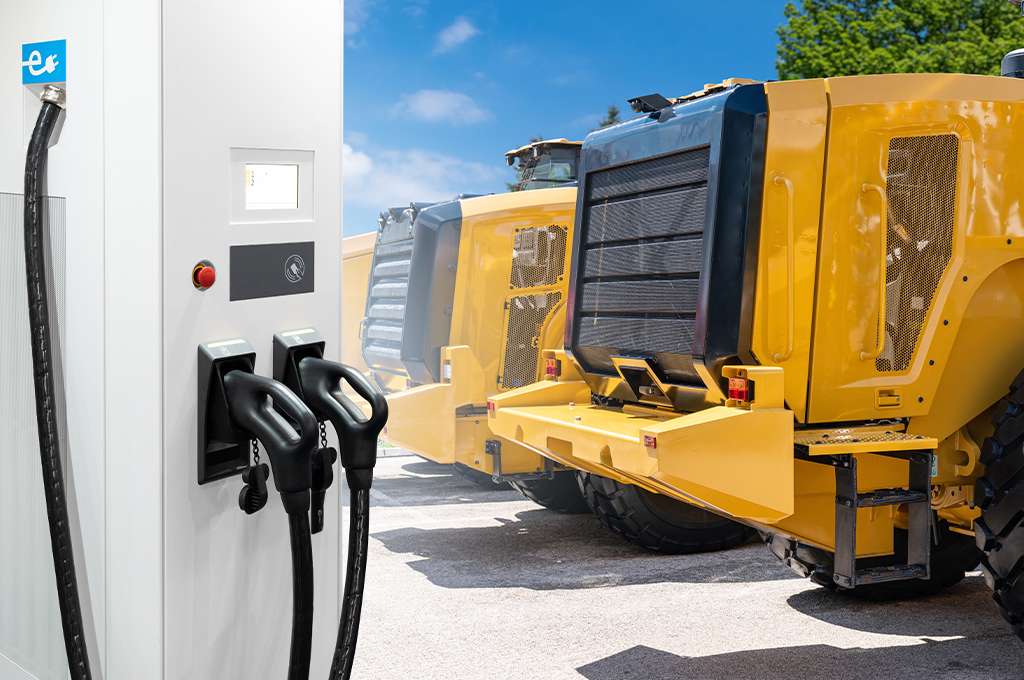
As in the automotive sector, electric options are increasingly gaining ground in the construction machinery industry as well. Stricter environmental regulations, technological progress, and a growing demand for zero-emission solutions are pushing companies in this direction.
The global market for electric earthmoving machines, which until a few years ago was still marginal and met with skepticism, is now expanding at a very rapid pace. By 2025, electric sales already account for a double-digit share in Scandinavia and China. By 2030, projections indicate that over 30% of new construction machines sold worldwide will be powered by electric motors.
The widespread use of electric technology across various types of construction sites shows that the technology is now mature for everyday operation.
LiuGong: the Chinese Pioneer
The main push toward the electrification of earthmoving machines comes from China, which in just a few years has gone from an emerging market to a global benchmark for electric construction equipment.
Today, LiuGong is the manufacturer that has accelerated this process more than any other, bringing to market machines capable of operating a full 8–10 hour shift on a single charge—an achievement that until recently seemed unattainable for machines of this size. The company has also developed large wheel loaders and excavators with battery capacities exceeding 400 kWh, particularly suited to ensuring long and stable life cycles even under heavy workloads.
These models demonstrate that electric power can replace diesel not only in compact machines, but also in medium and heavy classes, delivering more than satisfactory operating performance.
The real breakthrough delivered by Chinese manufacturers is the practical demonstration that the technology is already suitable for construction sites. This has created new benchmarks that the rest of the global market must now pursue, pushing all other manufacturers—including established brands—to accelerate their development programs.
Caterpillar and Volvo Accelerate Electrification
Until a few years ago, electric earthmoving machines were almost exclusively Asian. Today, the major historic names in construction equipment have also entered this market.
In particular, Caterpillar and Volvo Construction Equipment represent the two most significant examples of this second wave: a phase in which electric power is no longer just experimentation, but real-world application.
Volvo CE was the first among the major players to move openly in this direction, launching fully electric mini excavators and compact wheel loaders as early as 2020. In recent years, it has expanded its range with mid-size machines such as the EC230 Electric, a 23-ton excavator equipped with enlarged batteries that allow for 7–8 hours of real operating autonomy. This positioning has consolidated Volvo as the European reference point for electrification in the compact and mid-size segments.
Caterpillar has introduced prototypes and pre-series machines including excavators from 2 to over 20 tons, compact loaders, and other earthmoving equipment. This clearly indicates that the company is building a complete line of battery-powered machines to maintain its leadership position in the electric era.
The presence of electric machines from these traditional brands accelerates operator confidence, pushes service workshops to train on new technologies, and above all makes electric power a viable option for an increasing number of companies.
Electric Also Works in Earthmoving: Battery Evolution Changes the Rules
Until a few years ago, many industry professionals were convinced that electric power would never work in earthmoving, except for mini excavators and other low-power machines.
In recent years, even the most critical voices have changed their minds. Modern electric machines now deliver performance aligned with their diesel counterparts.
This paradigm shift has been made possible by the enormous technological leap in battery technology. Higher energy density, improved thermal management, more efficient electronics, and optimized hydraulic systems have made what once seemed an insurmountable limit achievable.
Next-generation electric wheel loaders and excavators operate with battery packs ranging from 200 to over 400 kWh, ensuring 6–10 hours of continuous operation. This demonstrates that even traditionally energy-intensive applications such as loading, lifting, and fast handling cycles can be sustained consistently.
These results are already remarkable, but further progress lies ahead. Battery technology evolution will continue to increase energy density.
This will lead to:
- more energy for the same weight,
- lighter batteries,
- longer cycle life,
- shorter charging times.
According to projections, within a few years electric earthmoving machines will be able to complete a full shift with batteries one-third the size of today’s, or, with the same installed capacity, cover double shifts.
This means that electric power is not only viable today, but still has enormous room for improvement. In short, we are only at the beginning of the revolution.
Earthmoving: In Five Years Everything Will Change
The most reliable projections indicate that within the next five years, 30–40% of new earthmoving machines sold worldwide will be electric.
This is a bold forecast, but one supported by three now-structural dynamics:
- the technology is mature,
- the push toward zero-emission construction sites is strong,
- the interest in reducing fuel costs is well established.
In countries that have already invested in this direction—such as Scandinavia, the Netherlands, and China—the transition to electric power, although still in its early stages, is already evident.
Italy, by contrast, has not yet been significantly affected by this wave of innovation. Registrations of electric machines remain marginal, and fleets continue to invest almost exclusively in diesel.
However, the situation is set to change soon. The arrival on the market of electric models from major Western manufacturers and the growing availability of tax incentives are likely to trigger a rapid catch-up phase in the coming years.
In other words, Italy is not a market resistant to electric power—it is simply too early to see the full impact of this new technology.
We are working to be ready. If you decide to evaluate an electric earthmoving machine, you can rely on our support.