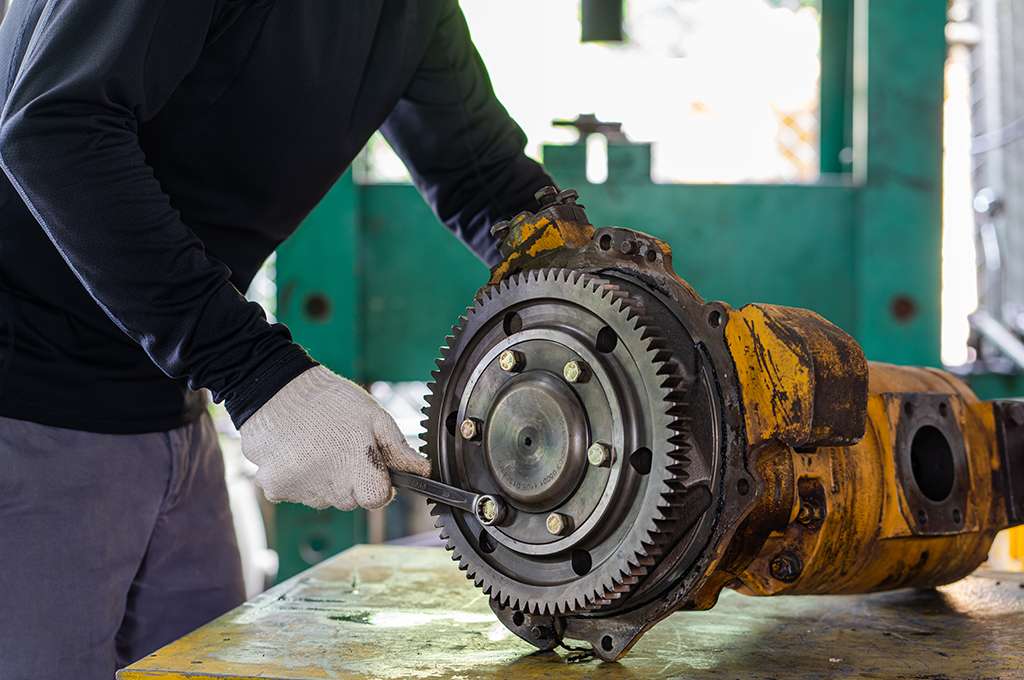
Repairing the engine of an earthmoving machine by replacing individual faulty components allows you to save money and extend the machine’s service life. This is a very useful practice for those operating in the used-equipment market or in the restoration of historic models.
However, it must be considered that a failure rarely remains isolated: it may involve multiple parts, and without an experienced technician a local issue can turn into a systemic problem. Even a new component installed in an already worn engine can create imbalances, especially in modern earthmoving machines, which feature complex electronic management systems and very tight tolerances.
In this article we will analyze the issue to understand when it really makes sense to rely on spare parts for earthmoving machines and when it is essential to replace the engine.
Understanding the nature of the failure
When evaluating whether to repair an engine “piece by piece,” the most important question is not which component has failed, but how that failure has interacted with the rest of the engine. In modern engines, many failures have a cascading effect: what appears to be a localized problem can quickly spread through the air, oil, or fuel circuits.
The fundamental distinction is therefore between contained failures, which allow for targeted intervention, and contaminating failures, where replacing a single component becomes risky.
When repair is still possible
There are cases in which the failure is truly isolated and has not compromised the rest of the system. In these situations, replacing a single spare part is an effective solution.
Contained failures include:
- Turbocharger with axial or radial play, without contact between the impeller and the housing.
- Worn seals that do not release metallic debris.
- Injector with an electrical or flow defect, provided it has not caused oil dilution.
- Non-critical pumps and sensors that do not affect lubrication or combustion.
The essential condition, however, is a verification of the engine’s condition, during which the following are carried out:
- Micrometric checks on pistons, liners, and mechanical clearances.
- Oil analysis to detect the presence of metals, fuel, or other contaminants.
- Visual inspection of the turbocharger, ducts, and manifolds.
If these checks confirm that the failure has not compromised other areas of the engine, repair is a viable option.
When repair is NOT possible
Many failures generate contamination that affects the entire engine. In these cases, repairing piece by piece is not only counterproductive, but also pointless, because the initial problem is likely to recur.
In particular, attention must be paid to:
- Air contamination: a turbo impeller failure can disperse debris into the air circuit, which passes through the intercooler and ends up in the combustion chamber. Since it is impossible to guarantee complete cleaning of the intercooler, the risk of subsequent cylinder damage is high.
- Oil contamination: an injector stuck open floods the cylinder with diesel fuel, removes the oil film, and carries fuel into the sump. Diluted oil loses viscosity, causing bearing wear.
- Stage V engines: in this case, EATS components (DPF, SCR, EGR valves, NOx sensors) are part of the engine’s homologation. Replacing individual non-compliant elements involves significant risks, both technical (software incompatibility, anti-tampering) and regulatory (loss of compliance).
Ordering individual spare parts: watch out for mistakes
When deciding to repair an engine “piece by piece,” the mistake almost never lies in the choice of the component itself, but in how the failure is interpreted. Here are three useful tips to avoid the most common and dangerous errors of this approach.
Replacing the broken part does not always solve the problem
It seems obvious, but an experienced mechanic knows this is true only for isolated, localized failures. In other cases, the failure may have already altered the engine.
In some situations, replacement components may even cause more problems than the old ones because they are installed in a system with a different degree of wear.
An experienced earthmoving-machine mechanic can analyze the engine and determine whether replacing a single component is truly sufficient.
Trying to recover intercoolers or ducts after turbo failure
This is one of the riskiest procedures. When the turbo impeller shatters, debris is forcibly pushed into the air circuit and, after a long path through various components, eventually enters the combustion chambers. Thoroughly cleaning a modern intercooler is extremely difficult and risky. Even a single residual fragment can score a liner or mark the valves, generating new failures shortly after the repair.
In practice, this makes replacing only the failed turbo unsafe.
Ignoring damage after oil dilution
An injector stuck open causes oil dilution. When oil loses viscosity, crankshaft and connecting-rod bearings wear simultaneously across all cylinders, not just the one where the failure occurred. Replacing only the failed component does not prevent very serious consequences such as the risk of rod knock or crankshaft failure. It is better not to take the risk.
Correct component identification: how to avoid mistakes
In earthmoving-machine engines, two parts that look identical can have completely different materials, geometries, software codes, or calibrations. If the wrong component is installed, the engine generally does not operate correctly or fails again after only a few hours.
For this reason, correct spare-part identification is one of the most critical phases.
Never rely solely on the engine family
This is the trap most easily fallen into by inexperienced technicians and parts dealers. In reality, within the same engine family there can be dozens of variants, different market specifications, incompatible mappings, and more.
In general, the engine family indicates only the base platform, not the actual configuration installed on the machine.
Never rely on visual similarity
Even when two components appear identical because they share the same shape and mounting points, they may actually differ in materials, sealing specifications, software, etc.
The greatest risk is not that the component will not work, but that it will work poorly, slowly but inexorably damaging the engine in which it is installed.
OEM codes are the number one reference
Correct identification of a spare part always requires the manufacturer’s official codes. From there it is possible to trace compatibility with engines and individual components.
To correctly identify a component, it is necessary to:
- Retrieve the complete engine code from the nameplate (not the machine model).
- Consult OEM documentation.
- Verify ECU compatibility when the component involves injection, sensors, or EATS.
- Request technical confirmation from the supplier in case of doubt.
Short Block and Long Block: a middle ground
When “piece-by-piece” repair is no longer safe, but replacing the entire engine is not necessary, there are two technical options that restore reliability and operational continuity: Short Block and Long Block.
Short Block
The Short Block is the factory-assembled mechanical core of the engine, which includes:
- Engine block
- Crankshaft
- Pistons
- Connecting rods
- Main and rod bearings
- Balancing and torquing performed in a controlled environment
Long Block
The Long Block includes all Short Block elements, plus:
- Complete cylinder head
- Valves, springs, rocker arms
- Camshaft
- Pre-timed timing system
- Head gasket
How to decide whether to repair or replace your engine
The choice between individual spare parts, Short Block, Long Block, or a complete engine depends on strictly technical criteria.
Below is a structured method that allows you to evaluate each case consistently. Remember, however, that only an experienced mechanic should make the decision, based on objective tests and considering not only the failed component but the entire ecosystem in which it operates.
When to choose individual spare parts
This is the right choice only if:
- the failure is truly isolated;
- no contamination has occurred, neither on the air side nor the oil side;
- electronics have not been involved;
- the machine is not Stage V (or, if it is, the intervention does not concern critical components).
When to choose the Short Block solution
This solution applies in the following cases:
- oil dilution above 5–7%;
- abnormal bearing wear;
- vertical scoring on multiple cylinders;
- out-of-round liners;
- main or rod bearing noise after an injection failure.
When to choose the Long Block solution
The Long Block is the ideal choice when:
- the turbo has shattered;
- the cylinder head has suffered deformation;
- EGR or the intake manifold are contaminated.
When to choose a complete engine
Complete engine replacement is mandatory when:
- there is severe air and oil contamination simultaneously;
- the engine is Stage V and the failure involves emission components or sensors;
- there are many engine variants and absolute certainty of compatibility is required;
- the engine has many operating hours;
- it is necessary to minimize machine downtime.
Repair or engine replacement? A decision table
|
Scenario |
Safest solution |
Technical reason |
|
Isolated failure, no contamination |
Individual spare parts |
Localized intervention |
|
Widespread damage to the crank mechanism |
Short Block |
Complete restoration of the lower end |
|
Damage also affecting the head or risk of debris ingestion |
Long Block |
Head restoration + correct timing |
|
Stage V with failure of critical components |
Complete engine |
Regulatory + electronic compatibility |
|
Shattered turbo + contaminated intercooler |
Long Block or complete engine |
Impossibility of safe decontamination |
|
Oil dilution |
Short Block or complete engine |
Wear throughout the engine |
Component replacement or engine replacement: practical examples
The criteria analyzed so far become truly useful when applied to the engines operators encounter every day on site.
In the following paragraphs we will use engines available in our workshops as examples, exploring their specific cases, variants, and issues.
If you are interested in these engine models, contact us to learn more.
Perkins 1204F-E44TAN – Doosan Code 150109-00944G
The Perkins 1204F-E44TAN equips models such as DL200-5 and DL200TC-5 and is compatible with the Caterpillar C4.4. It is a modern, Stage IV engine that can be repaired with good results as long as the problem remains localized: sensors, external pumps, minor injection adjustments, or a simply worn turbo are acceptable interventions.
The situation changes when aftertreatment systems and EGR come into play. In that case, the risk of errors and damage is very high. Differences between OEM versions within the same family can turn an apparently simple intervention into a compatibility problem. In such cases, complete engine replacement often becomes the only viable solution.
The most significant weakness of the 1204F is electronic management: installing a component with even a slightly different code can render the machine non-compliant.
Yanmar 4TNV98C-VDB8 – Doosan Code 150109-00580E
The 4TNV98C-VDB8 is found on models such as DX85R-3 and E85 Bobcat and belongs to a family widely used also on Takeuchi and Hyundai machines. It is an engine well suited to repair when failures are limited: pumps, sensors, gaskets, and injectors can be replaced without issues, provided there is no oil dilution. The absence of a complex electronic EGR further favors individual component replacement.
The picture changes when variant differences within the same family emerge, because the VDB8 coexists with versions that are externally very similar but internally different. Installing a similar but incompatible spare part is enough to introduce difficult-to-diagnose problems.
Spare-part replacement also becomes less convenient when EGR shows heavy deposits or when multiple failures are present. In these cases, complete engine replacement is the safest choice.
Yanmar 4TNV98C-VDB6 – Doosan Code 150109-00918A
The 4TNV98C-VDB6 is typically compatible with Doosan models such as DX63-3, DX63-5, and E63, but belongs to a family also used by John Deere, Hitachi, Hyundai, Liebherr, Gehl, and Yanmar. This wide diffusion makes the engine well known and relatively easy to repair when the failure is localized.
Difficulties arise when dealing with variants. For example, the VDB6 and VDB8 share many similar components, but are not fully interchangeable. Installing a component selected by family rather than exact code can cause operational issues or instability. ECU and injector calibration also requires precision.
If the engine has suffered overheating, the head may deform, making repair an uncertain investment. In such cases, engine replacement is often the safest choice.
Yanmar 4TN94L-XDB – Doosan Code 201-00166B
The 4TN94L-XDB, corresponding to Doosan code 201-00166B and installed on the Solar 55-V Plus, belongs to the Yanmar Tier II series, known for mechanical simplicity and broad interoperability with Takeuchi, Hyundai, and Doosan machines. On this engine, repair is effective as long as failures remain localized. The absence of EATS systems further reduces complexity and often makes repair the most effective choice.
On units with many operating hours, wear tends to be widespread, and any restoration attempt becomes economically fragile. Under these conditions, long blocks or complete engines are the most sustainable solutions.
Scania DC09389A – Doosan Codes 150109-00811B and 150109-00872G
The DC09389A engine, in variants 00811B and 00872G, equips excavators such as DX300LC-5 and DX380LC-5 and belongs to a Scania family known for robustness but also for high intervention costs. On these engines, repair makes sense when it concerns external and easily accessible elements.
For internal damage, the situation changes completely. On engines with many operating hours, widespread wear is almost inevitable and makes any repair an economic risk. Overheating often leads to head deformation and valve problems, while oil dilution and bearing noise strongly indicate a compromised crank mechanism. Further complicating the decision are differences between Doosan variants, which can generate software incompatibilities even when components appear identical. In all these scenarios, a complete engine or long block becomes more logical than repair.
Scania DC13387A – Doosan Code 150109-01177E
The DC13387A, compatible with Doosan DL450-5, DL550-5, and DL580-5 machines, is a robust engine, but with internal complexity that makes intervention truly worthwhile only when the problem remains external. This engine tolerates deep interventions poorly once compromised: when the issue goes beyond the surface, replacement tends to deliver better results than repair.
Non-critical sensors, auxiliary components, and minor leaks can be handled without particular risk, keeping costs under control and without compromising overall reliability.
The situation changes completely when signs of deeper damage appear. In these cases, engine replacement becomes an almost inevitable choice, because it reduces uncertainty and limits the risk of further failures after recommissioning.
Doosan D24NAP – Code DL02-LEE03-CE
The D24NAP, identified by Doosan code DL02-LEE03-CE and installed on the DX57W-5, belongs to the range of small Doosan diesel engines also compatible with S-7 series forklifts and Bobcat S450–S650 and T450–T650.
The model’s overall robustness, its wide diffusion, and low repair costs tip the balance toward replacement interventions.
The outlook changes when failures capable of affecting the engine core emerge, pushing the choice toward a long block or a complete engine.
This overview provides the elements needed for a more informed choice. For any questions about spare parts for your engine, we are at your disposal. Contact us.