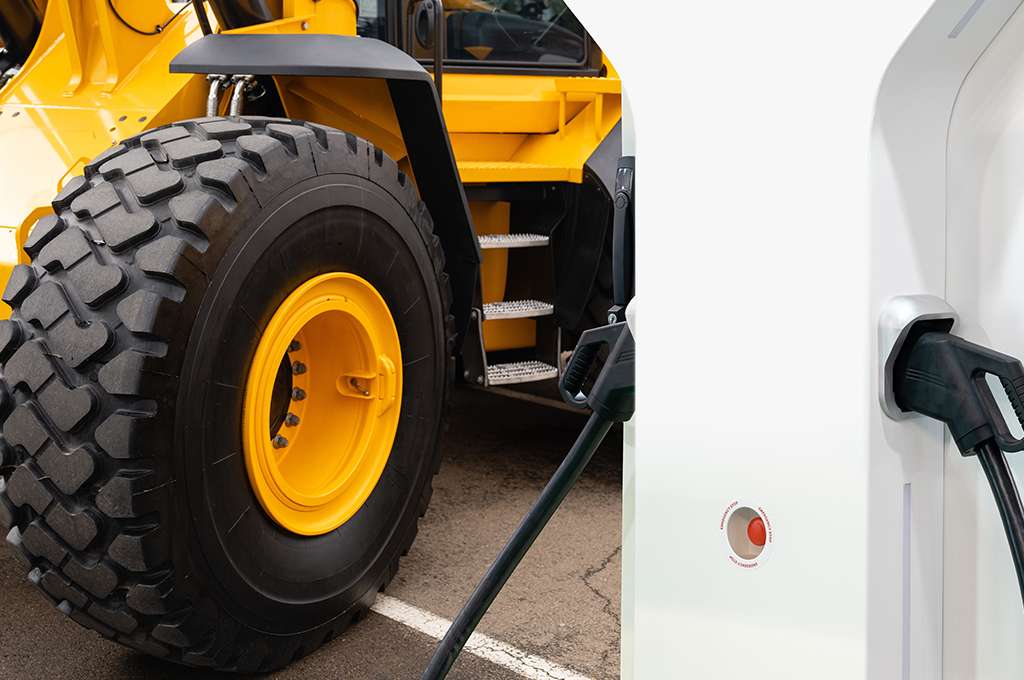
Electric earthmoving machinery is steadily gaining ground in the construction sector. Despite the delay compared to other European countries, interest in these technologies is also growing rapidly in Italy.
In this article we will analyze why electric earthmoving machines (EMM) are considered “green” solutions and are therefore eligible for Transizione 5.0 and PNRR incentives, as well as the strategic role of photovoltaic systems in making the electrification of construction sites economically sustainable. A comprehensive overview to understand why the shift to electric, year after year, will become increasingly concrete and advantageous.
Italy is lagging behind on electric EMMs, but not for long
Today, electric earthmoving machines are still not very widespread in Italy. The main difficulties are:
- Purchase costs that are too high for an average construction company,
- Limited availability of models on the national market,
- Charging infrastructure rarely available on construction sites,
- Technical skills related to electric motors that are still not widely spread,
- Skepticism, not to mention real prejudice, toward electric solutions.
However, market signals show that electric is the future of earthmoving, driven by stricter environmental regulations, operational requirements in urban areas, and an increasingly favorable return on investment.
To close the gap with more advanced European countries, the Italian government has activated a series of incentives that facilitate the adoption of electric earthmoving machines, reducing the burden of the initial investment and accelerating the spread of this technology in the Italian construction industry.
Why electric EMMs fall into the “green” category
Electric earthmoving machines are “green” because, having no internal combustion engines, they eliminate direct CO₂ emissions, completely removing the exhaust fumes typical of diesel engines. On an urban construction site this means:
- cleaner air,
- lower particulate concentration,
- reduced environmental impact.
The absence of combustion also leads to the complete elimination of NOₓ, fine particulates, and unburned hydrocarbons: all pollutants that affect operators’ health and overall air quality.
If the energy used for charging comes from renewable sources, the overall environmental impact is reduced even further, bringing these machines close to an almost zero-emission operating cycle. For these reasons, electric EMMs can access public incentives for the energy transition.
Transizione 5.0 incentives and PNRR funds for electrification
Transizione 5.0 and PNRR funds are currently the main tools for easing the initial investment required to purchase electric construction machinery. Below is a clear summary of how they work and the opportunities they offer.
Transizione 5.0 tax credit
The Transizione 5.0 program is the main incentive mechanism for purchasing electric machinery. It is based on a tax credit of up to 45% of the asset’s value, applicable to machines that meet two fundamental conditions:
- They must be new capital goods, equipped with digital technologies and monitoring systems (as with the former Industria 4.0 scheme).
- They must contribute to a measurable reduction in energy consumption of the production unit or process in which they operate.
In earthmoving operations, replacing diesel machines with electric equivalents makes it easy to demonstrate efficiency gains, thanks to lower consumption and the complete absence of fossil fuels. This makes electric EMMs among the most eligible assets under the 5.0 framework.
The role of the PNRR
The National Recovery and Resilience Plan (PNRR) covers a large portion of the funding for 5.0 measures, allocating significant resources to promote the transition to more energy-efficient technologies. In the electric earthmoving machinery sector, the PNRR has an impact in two ways:
- it finances the 5.0 tax credit, making it stable for 2024 and 2025;
- it encourages companies to adopt more sustainable working methods, a key requirement for participating in tenders, public bids, and contracts that require the use of zero-emission equipment.
By combining Transizione 5.0 with other incentives (such as the Nuova Sabatini Green or safety-focused grants), the cost of an electric machine can be significantly reduced, in some cases becoming more advantageous than an equivalent diesel model.
Photovoltaic panels: immediate incentives, free energy afterward
The transition to electric earthmoving machines becomes even more attractive when paired with photovoltaic systems.
Charging electric EMMs with self-produced energy means drastically reducing electricity costs.
Another important benefit of photovoltaics should also be considered: producing part of the energy independently allows companies to protect themselves from electricity price fluctuations.
Installing a photovoltaic system, especially for companies with warehouses, depots, or covered structures, makes it possible to cover a significant share of annual energy consumption, lowering the cost per kWh and making daily operations much more economical.
Moreover, the solar energy that powers the panels is free: once the installation cost has been amortized, the cost of charging batteries becomes negligible. In this case, electric solutions are far more competitive than diesel.
Transizione 5.0 and photovoltaics: a perfect synergy
Photovoltaics not only reduce charging costs, but also make a concrete contribution to improving a company’s energy efficiency, a decisive factor in meeting the requirements for the 5.0 tax credit.
Be careful, though! The tax benefit applies only if a real reduction in consumption can be demonstrated. Combining electric machines with a photovoltaic system makes this result easier to achieve and clearer to present to evaluators. When savings are demonstrable, it is possible to access the highest incentive brackets.
In short, photovoltaics are not a secondary element, but an accelerator of electrification: they improve sustainability, reduce costs, and open the door to incentives, all through a single integrated choice.
In this overview we have highlighted why electric earthmoving machines, combined with photovoltaics and 5.0 incentives, are becoming an increasingly advantageous choice for Italian construction sites.
If you would like clarification on incentives or on choosing electric EMMs, contact us: we will be happy to help!