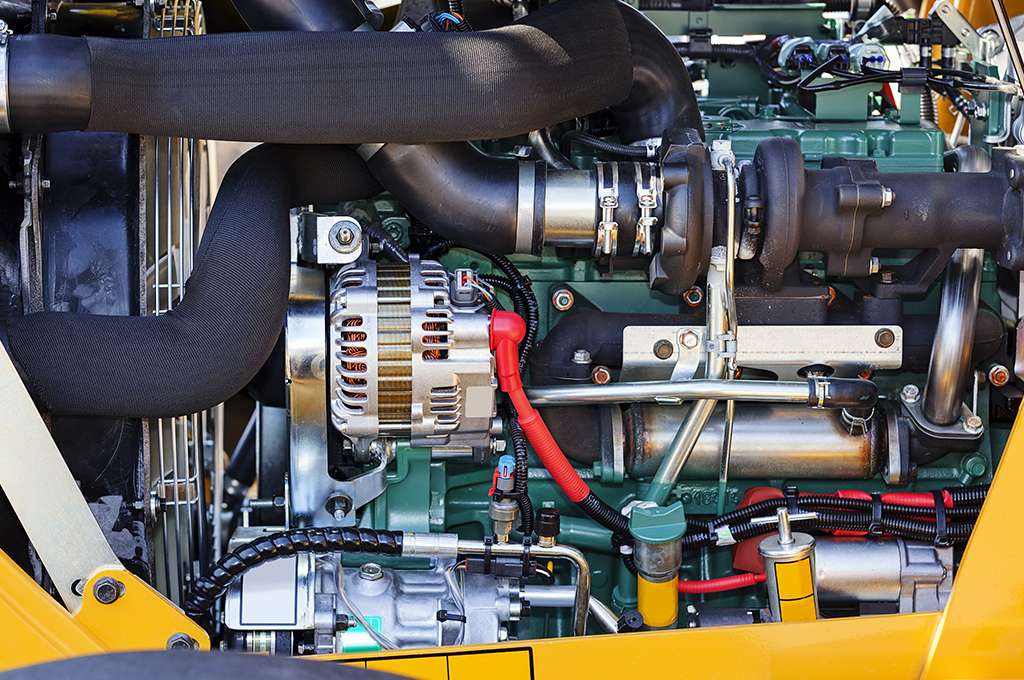
In modern earthmoving machinery, choosing between an engine overhaul and a complete replacement is no longer a trivial decision.
It is no longer enough to assess mechanical wear alone. Today, electronics, regulations, and ECU calibrations come into play. Another reason to consider engine replacement is the speed of the intervention, which is generally faster and reduces machine downtime.
In this article we analyze when it makes sense to install a complete “drop-in” engine, using practical criteria and real cases based on the units currently available in our workshops. The goal is to give you concrete tools to avoid mistakes, prevent incompatibilities, and make sound technical decisions.
Earthmoving engine maintenance: definitions
What an overhaul is
An overhaul is a deep restoration of the engine already installed on the machine.
The engine is disassembled, each part is inspected, and worn components are replaced.
In detail, experienced mechanics carry out:
- Repair or re-machining of the engine block and cylinder head;
- Inspection and possible replacement of wear components such as pistons, connecting rods, and gaskets;
- Overhaul or replacement of turbocharger, injection system, and pumps;
- Recalibration of the control unit (ECU) and injector codes;
- Checks on wear of wiring, sensors, and the exhaust/emissions system.
An overhaul does not automatically restore everything to factory condition. Even if the internal engine is rebuilt correctly, electronic components and sensors that cannot be replaced may remain worn.
What drop-in engine replacement is
Here, the old engine is not repaired but completely replaced with a new or remanufactured unit, already assembled and calibrated.
The complete engine is a preassembled unit consisting of:
- new block, cylinder head, and rotating assemblies;
- pre-calibrated injection system, turbocharger, and pumps;
- ECU and sensors aligned with OEM specifications;
- guaranteed mechanical and electronic compatibility.
It is installed in place of the old engine without the need for complex recalibration. This reduces downtime and lowers the risk of hidden issues.
Who this distinction is useful for
In themselves, both approaches are valid, but with different costs, downtime, and reliability. What changes are the specific needs of the company that will use the machine on site.
When is it better to choose a complete engine?
Based on our experience, the complete engine is generally the best solution:
- If you want to drastically reduce downtime, since engine installation is almost always faster than replacing individual components;
- If the machine is Stage IV/V and has complex systems such as DPF, EGR, and SCR, which require perfectly aligned control units;
- If the original engine has too many faults, making full repair too costly or technically complex;
- If the control unit is damaged or cannot be recovered;
- If many variants of the same engine exist, making it easy to choose incorrect components or calibrations when repairing “piece by piece”;
- If the risk of software incompatibility is high (in the case of Industry 4.0 earthmoving machines);
- If the value and age of the machine justify a fast and secure intervention.
Complete engine replacement for earthmoving machines: 5 mistakes to avoid
1. Buying the wrong engine variant
Surprisingly, this is the most common—and also the most expensive—mistake. Engines that appear identical can have small but critical differences, such as sensors, ECU maps, wiring, and connectors.
The result is installing an engine that does not work, or that works poorly and damages other machine components.
For this reason, it is essential to verify compatibility between the machine and the engine using manufacturer part numbers and official component compatibility tables.
2. Failing to verify ECU–VCU software alignment
A complete engine may be perfect, but attention must always be paid to the control unit. If its firmware is not compatible with the machine’s VCU, the engine will not start.
3. Ignoring the condition of wiring, sensors, and external components
Often the decision is made to replace the engine, but other issues remain in the machine chassis, such as aged wiring, faulty sensors, or dirty valves. Over time, these issues affect machine operation, which will perform poorly even with a high-quality engine.
4. Installing the engine without checking the emissions system
Emissions systems (DPF, EGR, SCR) and their sensors are part of an integrated ecosystem. If they are not carefully inspected, they can limit engine power.
5. Using contaminated oil circuits
A critical and often overlooked point. A new engine can be damaged after only a few hours if the oil cooler is contaminated. It is therefore good practice to thoroughly check this detail before replacing the engine.
Practical solutions: a table to choose consciously
To help you decide, we provide a table to guide your choice. In case of doubts, you can always contact us.
When to prefer a complete engine
|
Condition |
Implication |
|
High-hour engine |
Widespread wear makes repair or replacement of individual components uneconomical |
|
Multiple failures |
Too many individual replacements make repair complex |
|
Stage IV/V electronics |
Requires complex calibrations |
|
Multiple OEM variants of the same engine |
High risk of software incompatibility |
|
Invisible differences between component versions |
High probability of incompatible parts |
|
Need for minimal downtime |
Replacing the entire engine is faster than replacing individual components |
|
High-value machines |
Safer and justifies the financial investment |
Real cases from our workshops
Let’s get even more practical. In this section we address the topic using specific engines, to give you a perspective that is not only theoretical.
Remember that if you are interested in these engine models, you can contact us for more information.
Perkins 1204F-E44TAN on Doosan DL200-5
The Perkins 1204F-E44TAN used on the Doosan DL200-5 (part number Doosan 150109-00944G) can be installed on models such as DL200-5 and DL200TC-5. It is the same base engine group also used by Caterpillar, Hyundai, and McCloskey in the C4.4 version, making it part of a widely used family.
As an EU Stage IV engine, it complies with European emissions regulations for construction, agricultural, and industrial machinery, making it a low-emissions engine. However, the entire electronic system is particularly complex and requires perfectly aligned components. The DPF tends to clog quickly on high-hour engines, and the EGR valve accumulates deposits that can degrade performance.
For these reasons, when the engine begins to show serious problems, the emissions system is often already contaminated or partially compromised. Repairing only the engine core while leaving DPF, EGR, sensors, and wiring unchanged almost always leads to failed regenerations and further downtime. The complete engine, on the other hand, arrives already calibrated in the correct configuration and communicates seamlessly with the machine’s control unit, reducing risk and restoring much more stable reliability.
Yanmar 4TNV98C VDB6/VDB8 and 4TN94L-XDB on Doosan DX63-3 / DX63-5
The Yanmar 4TNV98C engine is available in several OEM variants. The 4TNV98C-VDB8 version (Doosan part number 150109-00580E) is installed on DX85R-3, Bobcat E85, and Bobcat E63, and is also used on Yanmar, Takeuchi, and Hyundai machines. The 4TNV98C-VDB6 variant (Doosan part number 150109-00918A) equips DX63-3, DX63-5, and E63, and is adopted by various earthmoving models including John Deere, Hitachi, Hyundai, Liebherr, Gehl, and Yanmar. This family is complemented by the 4TN94L-XDB (part number Doosan 201-00166B) installed on the Solar 55-V Plus as a Tier II engine, compatible with Yanmar, Hyundai, and Doosan.
The 4TNV98C versions can be configured by OEMs with different emissions kits depending on year and market. Some include EGR systems or Common Rail injection, while others remain simpler. As a result, common operational issues vary: EGR or electronically managed injection versions may experience deposit buildup, starting difficulties, or irregular response, while in more advanced variants compatibility between ECU, sensors, and wiring becomes critical. The 4TN94L-XDB, being Tier II, does not use DPF or complex after-treatment systems and presents different issues, more related to mechanical wear than electronic management.
When work is carried out only on the internal engine while leaving external components such as EGR, wiring, sensors, or the fuel system unchanged, any electronic or calibration issues tend to reappear. In these cases, installing a complete engine in the exact variant required by the machine (VDB6 or VDB8) reduces the risk of ECU incompatibility, avoids recurring faults, and prevents the common mistake of installing a similar but not truly compatible version.
Scania DC09389A
The Scania DC09 and DC13 engines are used on several Doosan models, each with a specific variant. The Scania DC09389A version with Doosan part number 150109-00811B is installed on DX300LC-5 and DX300LL-5, while the same base engine with part number 150109-00872G equips larger models such as DX380LC-5, DX400LC-5, and DX380LL-5. This family also includes DC13 series variants: the Scania DC13387A with Doosan part number 150109-01177E, used on DL450-5, and the Scania DC13 387A with part number 150109-01246, installed on DL550-5 and DL580-5. Although these engines share the same basic architecture, each Doosan variant has dedicated calibrations, components, and electronic configurations, making correct part identification essential.
A full overhaul of these engines requires many labor hours, both due to the size of the unit and the complexity of the electronic systems. In the presence of heavy wear or multiple failures, dismantling and rebuilding the entire engine results in significant downtime for inspections, testing, and realignment.
For this reason, in the most critical cases choosing a complete engine is more effective: the unit arrives already configured in the exact variant required by Doosan, eliminates the risk of software incompatibility between ECU and machine, significantly reduces downtime, and guarantees higher reliability compared to a deep, piece-by-piece overhaul.
Doosan D24NAP
The Doosan D24NAP engine, identified by part number DL02-LEE03-CE, is installed on the DX57W-5 model and is the same base unit used in numerous Doosan forklifts, such as D20S-7, D25S-7, D30S-7, D33S-7, and D35C-7, as well as on several Bobcat models including S450, S510, S530, S550, S570, S590, S595, S630, and S650, and on compact track loaders T450, T550, T590, T595, T630, and T650. Its wide use across different machines and brands means that multiple variants exist, each specifically calibrated for its application, particularly in terms of electronic management, power output, and auxiliary systems.
This broad compatibility makes it essential to correctly identify the version intended for the target machine, as invisible differences between variants can cause starting problems, ECU mismatches, or inconsistent performance. In cases of multiple failures or heavy wear, opting for a complete engine in the exact variant once again helps avoid incompatibilities, reduce downtime, and restore the machine to optimal operating conditions.
If you need to evaluate a replacement or have doubts about compatibility between the engine versions you require, contact us.