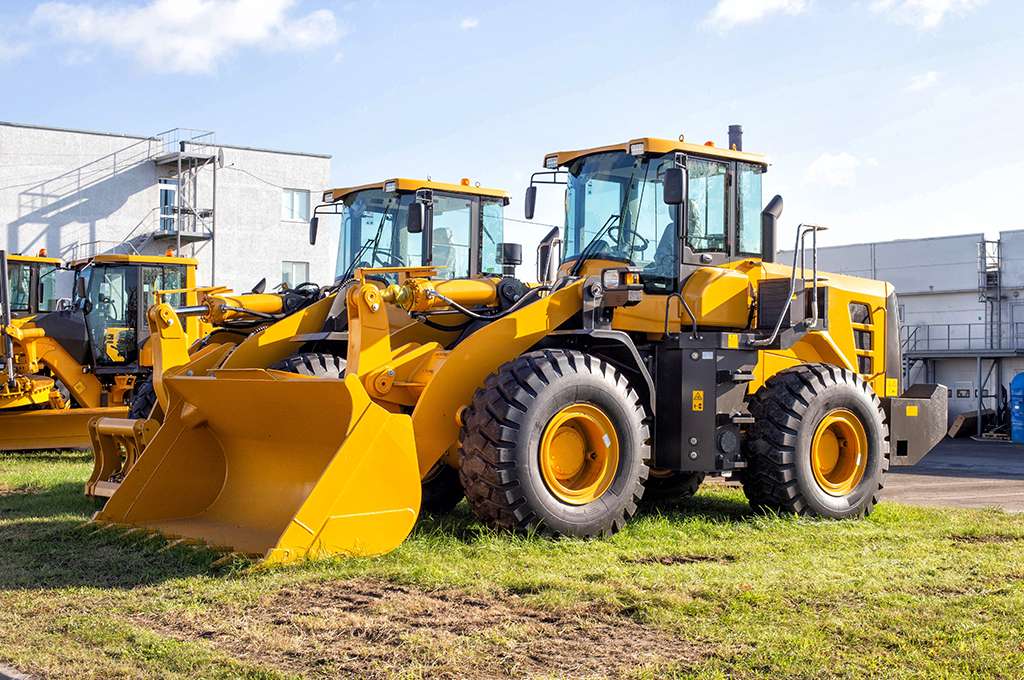
The wheel loader is an earthmoving machine designed to collect and move loose materials such as earth, sand, gravel and debris. Equipped with a large front blade attached to the frame by hydraulic arms, the wheel loader guarantees a higher loading efficiency than other equipment, such as the excavator. With a high load capacity and ease of movement, it is ideal for operations that require the rapid movement of large volumes of material.
What is the wheel loader used for?
The wheel loader is an essential tool in many industries, including construction, mining and agriculture, thanks to its extraordinary robustness and versatility.
In the construction industry, it is used to move and load materials such as sand, gravel, earth and rocks. These materials are often transported in large quantities over short distances, for example to fill excavations or move debris during construction and demolition operations.
In the mining industry, the wheel loader is particularly appreciated for its ability to handle heavy materials such as coal, raw minerals and rocks. Its components, such as the hydraulic arms and the bucket, are designed to withstand the wear caused by continuous contact with these materials, which are often very hard and irregular.
In the agricultural sector, however, the wheel loader is used in the movement of fertilizers, manure, fodder and even agricultural waste materials. It is ideal for quickly moving large quantities of hay, fertilizers or agricultural waste, making loading and unloading operations more efficient and saving time and effort for operators in the sector.
Differences between a wheel loader and a tracked loader
A wheel loader and a tracked loader are both loader shovels. Their area of use is in fact the same.
What distinguishes them is the movement system: the wheel loader uses wheels with tires, while the tracked loader is equipped with tracks.
This difference makes the wheel loader ideal for working on hard surfaces and roads, while the tracked loader offers greater stability on steep and uneven terrain.
The smallest wheel loaders: mini wheel loaders
When the wheel loader weighs between 18 and 50 quintals, it is considered a mini wheel loader.
Mini wheel loaders are perfect for construction sites with limited space, where it is not practical to use large machinery.
• Large Wheel Loaders
When it is possible to work in open fields, or if it is necessary to move large quantities of material in a short time, large wheel loaders are available on the market. Naturally, their mass, capacity and operating cost are related to their size, which can vary greatly.
The largest wheel loader ever built to date is the LeTourneau L-2350 model, with a load capacity of about 40 cubic meters. For reference, the most common large wheel loaders on the market have a capacity ranging from 12 to 18 cubic meters, so less than half of this giant!
Wheel loader brands and models
Manufacturers around the world offer versatile and specialized solutions, capable of satisfying every earthmoving need. Among the most well-known brands we find:
- Caterpillar: also known as CAT, it is a point of reference in the construction machinery market. Among its most famous wheel loader models are the Caterpillar 992G, with a bucket capable of loading up to 12 m3, and the Caterpillar 966, a medium-sized machine appreciated for its ease of use. Other famous models are the Caterpillar 908, 988, 950 G loaders.
- Volvo: famous not only for cars, but also for its earthmoving machines, including a wide selection of wheel loaders including the Volvo 120 and L35 wheel loaders.
- Bobcat: specialized in mini wheel loaders, such as the very agile S100, designed to operate in tight spaces thanks to its compact size and maneuverability.
- Develon: Heir to the famous Doosan brand, it offers several top models, the most popular of which are the DL 250, DL 350 and DL 420
- Komatsu, JCB, Hyundai, Hitachi and Liebherr: Each of these brands offers specific models of wheel loaders and mini wheel loaders, suitable for a variety of applications in different sectors. Among the most popular vehicles are the Komatsu 320 wheel loader, the JCB 436 wheel loader, the Hitachi ZW 180 wheel loader and the Liebherr 586 wheel loader. New Holland, a well-known manufacturer of tractors and agricultural machinery, is also appreciated for models such as the New Holland W170 wheel loader.
Wheel loader prices
The price of a wheel loader can vary greatly. In general, it ranges from around 80,000-100,000 euros for the smallest models to over 500,000 euros for a new large machine. Factors that influence price include:
- Brand: More famous brands tend to have higher prices.
- Size: A higher load capacity usually means a higher cost.
- Year of manufacture: Newer models generally have higher prices.
- Options and accessories: As with cars, basic models cost less than those with extras. For example, a telescopic wheel loader or a wheel loader with an excavator will cost more than a basic model.
For those looking to save money, the used market is a great solution: a used wheel loader can cost much less, and reliable machines are often available at competitive prices. Good prices can also be found at judicial auctions, although competition and delivery times make this an option that is not always easy to achieve.
Tips for buying used wheel loaders:
- Check the hours of operation: Like a car odometer, earthmoving machinery have a time of use meter. The more hours the machine has, the greater the chance of getting a lower price.
- Inspect the machine: Observing and, if possible, testing the machine before purchasing helps to verify its condition. It is useful to bring an expert with you.
- Possibility of replacing components: If the machine is in good condition but has worn parts, it is possible to replace the parts with reconditioned spare parts.
Those who prefer to rent will find numerous options for renting loaders of various sizes, with daily or monthly rates. Here too, the costs depend on the brand, size and equipment.
Spare parts for wheel loaders
The components most subject to wear in wheel loaders are the hydraulic arms, buckets and various mechanical parts which, being often subjected to stress or contact with abrasive materials, require regular maintenance and replacement to ensure optimal performance. Fortunately, the market offers a wide range of spare parts, both for recent and older models. Among specialized suppliers, it is possible to choose specific solutions to extend the life of the machine and maintain its operational efficiency.
If you want to buy a new wheel loader, take advantage of the current tax breaks! Contact RAMI today to discover the offers and benefits: it is the ideal time to renew your fleet of machines with cutting-edge solutions.
The 4 types of spare parts for wheel loaders
The spare parts available are generally of three types: new, used and reconditioned.
- New spare parts come directly from the manufacturer and have never been used, guaranteeing maximum reliability.
- Used spare parts, on the other hand, come from machines already in use but still in good condition: they represent an economical choice and are suitable for machines that have already accumulated many hours of work.
- Finally, reconditioned spare parts are used components but overhauled to offer performance similar to that of a new spare part, with an intermediate cost between new and used.
- Aftermarket parts are parts produced by a company other than the manufacturer of the machine to be repaired, but have the same technical specifications and are generally less expensive.
The type of part you choose depends on the condition and age of the machine:
- New or under warranty machines: To ensure compatibility and maintain warranty coverage, it is advisable to opt for new or original parts, often recommended by the manufacturer.
- Machines with many hours of work: A reconditioned part is a cost-effective solution, combining good value for money with reliability. Quality aftermarket parts can also be considered.
- Older models: For older wheel loaders, original parts may no longer be available. In these cases, reconditioned or aftermarket parts become the best choice.
- Machines nearing the end of their operating life: To maximize use at a low cost, cheap used parts can be an ideal solution.
It is essential to always check the compatibility of the part, regardless of the type chosen. An incompatible component could cause serious damage to the machine. To avoid mistakes, rely on the support of industry experts and choose reliable spare parts suppliers.
If you are looking for spare parts for wheel loaders, visit rami-spare.it! You will find a wide selection of filters, pistons, gaskets and much more, available both as original spare parts and as reconditioned and aftermarket. Choose from thousands of items to meet every need of your operating machine. Don't wait: explore our catalog and find the perfect component for your wheel loader!